 Ultrafast Spectroscopy
Ultrafast Spectroscopy
Low-dimensional materials exhibit rich optically-excited states, and have great potential for next-generation optoelectronics. While free photocarriers and excitons are among the most popular fundamental excitations in low-dimensional materials, the advent of 2d semiconductors, especially transition-metal dichalcogenides (TMDCs), have led to excitingly new optically-excited states, such as valley-polarization. The exciton physics in TMDCs is further enriched by inter-layer excitons and twist-angle-dependent periodic moiré potentials.
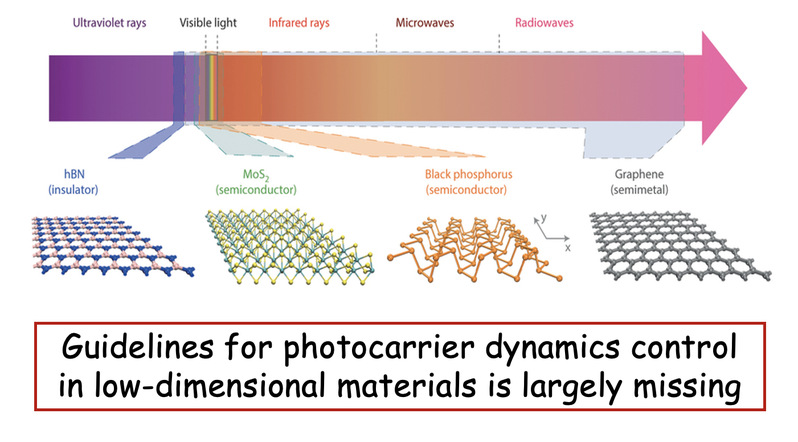
Ultrafast spectroscopy is a powerful optical technique for capturing transient dynamics of photocarriers/excitons. Obtaining insights about the relaxation dynamics of photo-excitations may help design either ‘better-performing’ or ‘disruptive’ photonic devices. For example, strategies to elongate valley-polarization lifetimes may allow robust operation when the ‘valley bit’ is processed. Shortening interfacial carrier lifetimes, on the other hand, could help design phototransistors with fast response time. Our group is interested in studying the photoexcitation dynamics of emerging low-dimensional materials, with a particular focus on identifying physical knobs that can control the relaxation dynamics. To that end, we have built several time-resolved spectroscopy systems (including both pump-probe and time-resolved PL) covering a broad wavelength range from 400nm to 6,000 nm.
Related group publications:
Light: Science & Applications 9, 192 (2020) Communications Physics 2, 103 (2019) Opt. Letters 44, 4103 (2019) Nanoscale Horizons 4, 1099 (2019) Nanoscale 9, 18546 (2017) Nature Communications 8, 14111 (2017) | Appl. Phys. Lett. 118, 121104 (2021) Appl. Phys. Lett. 117, 011102 (2020) Appl. Phys. Lett.112, 031108 (2018) Appl. Phys. Lett. 112, 171112 (2018) Appl. Phys. Lett. 111, 091101 (2017) Appl. Phys. Lett. 111, 031906 (2017) |